The Gaia spacecraft, designed to map the three-dimensional structure of our Galaxy, has provided a rich database of precision measurements enabling other types of science, most recently the discovery of exoplanets orbiting target stars. In a recent report by Aviad Panahi (Tel Aviv University) and collaborators, Gaia photometry was used for the first time to identify candidate exoplanet transit events, signaled by a dip in a star’s brightness as an orbiting planet passes along our line of sight and covers a part of the stellar disk.
Confirmation that the temporary dimming was the result of an orbiting exoplanet was obtained for two sources, with spectra from the Potsdam Echelle Polarimetric and Spectroscopic Instrument (PEPSI) on the Large Binocular Telescope. The data acquired over multiple epochs provide sensitive measures of the star’s radial velocity (i.e. speed of motion along our line of sight) which oscillates over time as the star is pulled by the gravity of an orbiting planet.
The LBT data enable estimation of the planets’ mass which in both cases resembles that of Jupiter. However, the newly discovered exoplanets orbit in close proximity to their parent stars, with periods of only 3 – 4 days, resulting in surface temperatures in excess of 1000 K. The discovery of these “hot jupiters” is an important demonstration of the potential for Gaia to extend the census of extrasolar planets.
The study findings are reported in Panahi et al. 2022, Astronomy & Astrophysics, 663, A101
Thursday, August 25, 2022

Tuesday, June 14, 2022
A weird star produced the fastest nova on record
A team of users of the Large Binocular Telescope has recorded the
fastest nova ever. They hope to find answers to not only the nova’s many baffling
traits, but to larger questions about our solar system and the universe.
Astronomers
are buzzing after observing the fastest nova ever recorded. The unusual event
drew scientists’ attention to an even more unusual star. As they study it, they
may find answers to not only the nova’s many baffling traits, but to larger
questions about the chemistry of our solar system, the death of stars and the
evolution of the universe.
The research team, led by Arizona State University Regents Professor Sumner Starrfield, Professor Charles Woodward from University of Minnesota and Research Scientist Mark Wagner from The Ohio State University, co-authored a report published in the Research Notes of the American Astronomical Society.
The bright nova usually fades over a couple of weeks or longer. On June 12, 2021, the nova V1674 Hercules burst so bright that it was visible to the naked eye — but in just over one day, it was faint once more. It was like someone flicked a flashlight on and off.
Nova events at this level of speed are rare, making this nova a precious study subject.
“It was only about one day, and the previous fastest nova was one we studied back in 1991, V838 Herculis, which declined in about two or three days,” says Starrfield, an astrophysicist in ASU’s School of Earth and Space Exploration.
As the astronomy world watched V1674 Hercules, other researchers found that its speed wasn’t its only unusual trait. The light and energy it sends out is also pulsing like the sound of a reverberating bell.
Every 501 seconds, there’s a wobble that observers can see in both visible light waves and X-rays. A year after its explosion, the nova is still showing this wobble, and it seems it’s been going on for even longer. Starrfield and his colleagues have continued to study this quirk.
“The most unusual thing is that this oscillation was seen before the outburst, but it was also evident when the nova was some 10 magnitudes brighter,” says Wagner, who is also the head of science at the Large Binocular Telescope Observatory being used to observe the nova. “A mystery that people are trying to wrestle with is what’s driving this periodicity that you would see it over that range of brightness in the system.”
The team also noticed something strange as they monitored the matter ejected by the nova explosion — some kind of wind, which may be dependent on the positions of the white dwarf and its companion star, is shaping the flow of material into space surrounding the system.
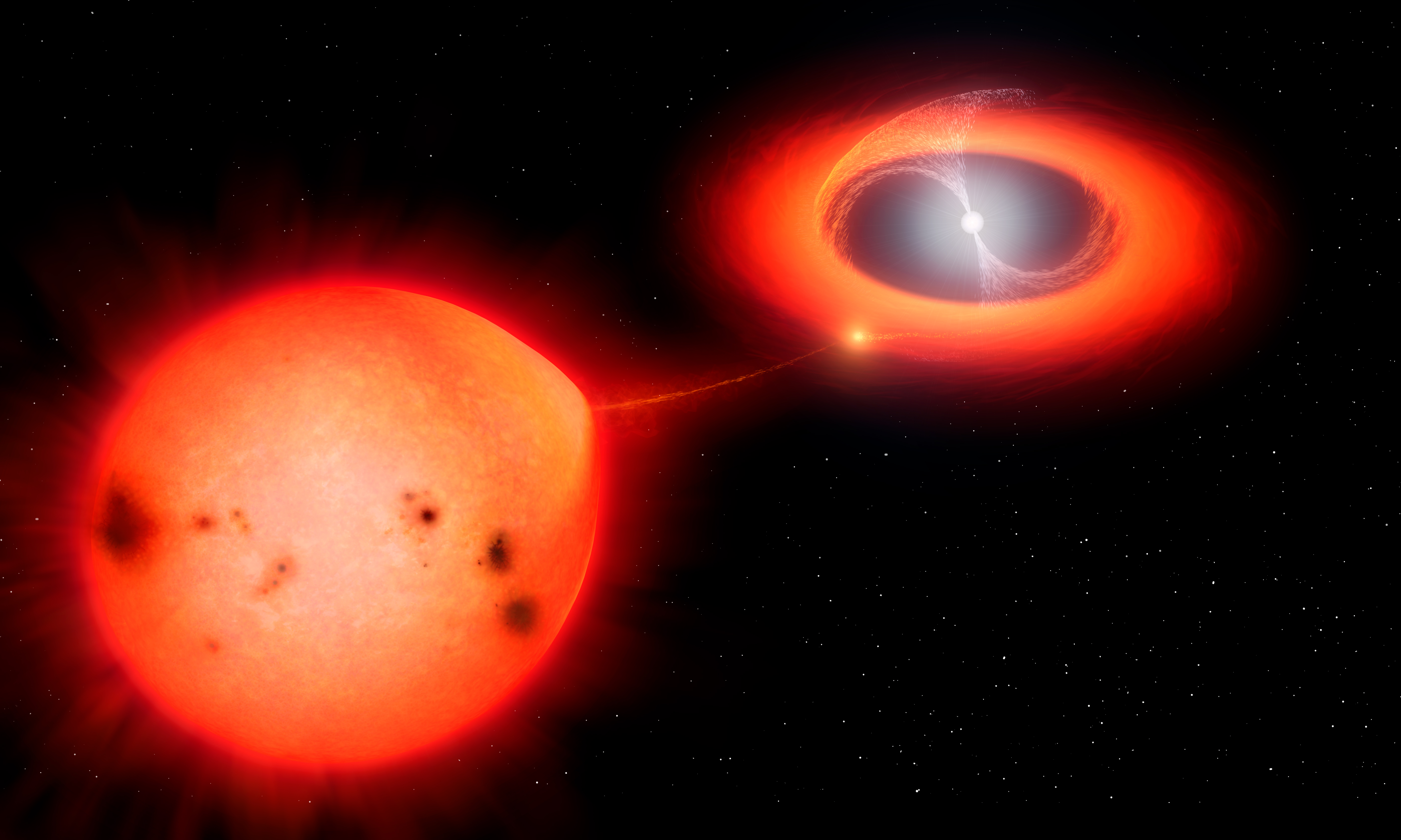 |
Though the fastest nova is (literally) flashy, the reason it’s worth further study is that novae can tell us important information about our solar system and even the universe as a whole.
A white dwarf collects and alters matter, then seasons the surrounding space with new material during a nova explosion. It’s an important part of the cycle of matter in space. The materials ejected by novae will eventually form new stellar systems. Such events helped form our solar system as well, ensuring that Earth is more than a lump of carbon.
Sometimes a white dwarf star doesn’t lose all of its collected matter during a nova explosion, so with each cycle, it gains mass. This would eventually make it unstable, and the white dwarf could generate a type 1a supernova, which is one of the brightest events in the universe. Each type 1a supernova reaches the same level of brightness, so they are known as standard candles.
“Standard candles are so bright that we can see them at great distances across the universe. By looking at how the brightness of light changes, we can ask questions about how the universe is accelerating or about the overall three-dimensional structure of the universe,” Woodward says. “This is one of the interesting reasons that we study some of these systems.”
Additionally, novae can tell us more about how stars in binary systems evolve to their death, a process that is not well understood. They also act as living laboratories where scientists can see nuclear physics in action and test theoretical concepts.
The nova took the astronomy world by surprise. It wasn’t on scientists’ radar until an amateur astronomer from Japan, Seidji Ueda, discovered and reported it.
 |
| MODS1 & MODS2, the pair of LBTO multi-object double spectrographs used by the team, seen while the telescope is pointed at horizon. Photo credit: Rick Pogge. |
Citizen scientists play an increasingly important role in the field of astronomy, as does modern technology. Even though it is now too faint for other types of telescopes to see, the team is still able to monitor the nova thanks to the Large Binocular Telescope’s wide aperture and its observatory’s other equipment, including its pair of multi-object double spectrographs (MODS) and exceptional PEPSI high resolution spectrograph.
They plan to investigate the cause of the outburst and the processes that led to it, the reason for its record-breaking decline, the forces behind the observed wind, and the cause of its pulsing brightness.
Wednesday, June 8, 2022
AN UNEXPECTED GAMMA RAY BURST
An international group led by INAF researchers have confirmed that the gamma-ray burst GRB 200826A, which lasted less than two seconds – typical of short bursts – is associated with the explosion of a massive star, which is typical of long gamma-ray bursts. The study, involving also several universities and research institutes in Italy, is primarily based on data collected with the Large Binocular Telescope in Arizona, USA. The observations made the first ever use of adaptive optics to observe a supernova associated with a gamma-ray burst.
Tuesday, May 31, 2022
Announcing the new Director of the Large Binocular Telescope
The Large
Binocular Telescope Observatory, one of the largest and most advanced optical
telescopes in the world, is proud to announce the appointment of its new Director,
Prof. Joseph Shields, who will
assume the position effective June 06, 2022.
 |
| Prof. Joseph Shields |
Dr. Shields
received his bachelors degree from the University of Kansas and his PhD in
Astronomy from the University of California at Berkeley. He held a postdoctoral
appointment at the Ohio State University and a Hubble Fellowship at the
University of Arizona prior to joining the faculty at Ohio University. In his
research, Shields studies the physics
of supermassive black holes in
galaxies, using both ground-based and space-based observatories. He is also
interested in the interstellar medium,
star formation, and supernovae. He is an
author on more than 110 papers in the peer-reviewed literature, and served for
four years as a Scientific Editor of the Astrophysical
Journal.
The LBT Board of Directors appointed Prof. Shields to serve as the Observatory’s new director following an extensive international search.
“We are excited to welcome Joe and look forward to
working with him to maintain the prominent position of LBT as a world-class
astronomical facility,” stated Adriano Fontana,
Chair of the LBT Board of Directors. “Joe
has a unique combination of astronomical experience, scientific vision and
managerial capabilities that make him the perfect match for LBT. Joe will build
on the unique role of LBT in fostering new astronomical discoveries and the
development of cutting-edge observational techniques associated with adaptive
optics and interferometry.“
In accepting the Director position, Shields commented: “I am pleased and honoured to have the opportunity to lead the talented LBTO staff during the observatory’s next phase as a pioneer in the realm of extremely large optical telescopes. The LBT has a storied history and vibrant future in technological innovation and astronomical discovery, enabled by the distinctive expertise of its partner institutions.”
The LBT Board of Directors also extended its appreciation to Dr. Christian Veillet, who successfully led the Observatory during the last ten years, completing the installation and commissioning of the initial suite of scientific instruments.
LBT is a unique astronomical facility. Located on Mt. Graham in southeast Arizona, at an elevation of 3200m/10000 ft, the LBT has two 8.4m (27.5 feet) mirrors side-by-side like a pair of binoculars for a combined collecting area of a single 11.8m (38.7 feet) telescope. This unique design gives it the capabilities of a 23-m (75.5 feet) telescope in some observing modes, making it the first of the next-generation extremely large telescopes.
The LBT is an international collaboration among institutions in the United States, Italy and Germany. LBT Corporation partners are: The University of Arizona on behalf of the Arizona Board of Regents; Istituto Nazionale di Astrofisica, Italy; LBT Beteiligungsgesellschaft, Germany, representing the Max-Planck Society, The Leibniz Institute for Astrophysics Potsdam, and Heidelberg University; The Ohio State University, representing OSU, University of Notre Dame, University of Minnesota and University of Virginia.
Thursday, November 11, 2021
Near-Earth Asteroid Might be a Lost Fragment of the Moon
A team of UArizona-led researchers think that the near-Earth asteroid Kamo`oalewa might actually be a miniature moon.
A near-Earth asteroid named Kamo`oalewa could
be a fragment of our moon, according to a new paper published in Nature
Communications Earth and Environment by a team of astronomers led by the University
of Arizona.
Kamo`oalewa is a quasi-satellite – a subcategory
of near-Earth asteroids that orbit the sun but remain relatively close to Earth.
Little is known about these objects because they are faint and difficult to
observe. Kamo`oalewa was discovered by the PanSTARRS telescope in Hawaii
in 2016, and the name – found in a Hawaiian creation chant – alludes to an offspring
that travels on its own. The asteroid is roughly the size of a Ferris wheel –
between 150 and 190 feet in diameter – and gets as close as about 9 million
miles from Earth.
Due to its orbit, Kamo`oalewa can only be observed
from Earth for a few weeks every April. Its relatively small size means that it
can only be seen with one of the largest telescopes on Earth. Using the UArizona-managed
Large Binocular Telescope on Mount Graham in southern Arizona, a team of
astronomers led by planetary sciences graduate student Ben Sharkey found
that Kamo`oalewa's pattern of reflected light, called a spectrum, matches lunar
rocks from NASA's Apollo missions, suggesting it originated from the moon.
The team can't yet be sure how it may have broken
loose. The reason, in part, is because there are no other known asteroids with
lunar origins.
"I looked through every near-Earth asteroid
spectrum we had access to, and nothing matched," said Sharkey, the paper's
lead author.
The debate over Kamo`oalewa's origins between Sharkey
and his adviser, UArizona associate professor Vishnu Reddy, led to another
three years of hunting for a plausible explanation.
"We doubted ourselves to death," said Reddy,
a co-author who started the project in 2016. After missing the chance to
observe it in April 2020 due to a COVID-19 shutdown of the telescope, the team found
the final piece of the puzzle in 2021.
"This spring, we got much needed follow-up
observations and went, 'Wow it is real,'" Sharkey said. "It's easier
to explain with the moon than other ideas."
Kamo`oalewa's orbit is another clue to its lunar
origins. Its orbit is similar to the Earth's, but with the slightest tilt. Its orbit
is also not typical of near-Earth asteroids, according to study co-author Renu
Malhotra, a UArizona planetary sciences professor who led the orbit
analysis portion of the study.
"It is very unlikely that a garden-variety near-Earth asteroid would spontaneously move into a quasi-satellite orbit like Kamo`oalewa's," she said. "It will not remain in this particular orbit for very long, only about 300 years in the future, and we estimate that it arrived in this orbit about 500 years ago," Malhotra said. Her lab is working on a paper to further investigate the asteroid's origins.
 |
| An artist impression of Earth
quasi-satellite Kamo`oalewa near the Earth-Moon system. Astronomers
using the Large Binocular Telescope have shown that it might be a lost
fragment of the moon. Credit: Addy Graham/University of Arizona |
Kamo`oalewa is about 4 million times fainter than the faintest star the human eye can see in a dark sky.
"These challenging observations were enabled by
the immense light gathering power, of the twin 8.4-meter telescopes of the
Large Binocular Telescope," said study co-author Al Conrad, a staff
scientist with the telescope.
The study also included data from the Lowell Discovery
Telescope in Flagstaff, Arizona. Other co-authors on the paper include Olga
Kuhn, Christian Veillet, Barry Rothberg and David Thompson
from the Large Binocular Telescope; Audrey Thirouin from Lowell Observatory and
Juan Sanchez from the Planetary Science Institute in Tucson. The research was
funded by NASA's Near-Earth Object Observations Program.
Tuesday, October 26, 2021
Astronomers Discover a Massive Galaxy 'Shipyard' in the Distant Universe
Even galaxies don't like to be alone. While astronomers have known for a while that galaxies tend to congregate in groups and in clusters, the process of going from formation to friend groups has remained an open question in cosmology.
In a paper published in the Astronomy & Astrophysics Journal, an international team of astronomers reports the discovery of objects that appear to be an emerging accumulation of galaxies in the making – known as a protocluster.
"This discovery is an important step toward reaching our ultimate goal: understanding the assembly of galaxy clusters, the most massive structures that exist in the universe," said Brenda Frye, an associate professor of astronomy at the University of Arizona's Steward Observatory and a co-author of the study.
To cite a local analog, the Milky Way, the galaxy that is home to our solar system, belongs to a galaxy cluster known as the Local Group, which in turn is a part of the Virgo supercluster. But what did a supercluster such as Virgo look like 11 billion years ago?
Want to know more, follow this link!
 |
| The pair of LUCI spectrographs, on the LBT, was one of the ground-based instruments used for this work. |
Saturday, December 12, 2020
That young but already evolved entirely self-made galaxy
So young and already so evolved: thanks to observations obtained at the Large Binocular Telescope, an international team of researchers coordinated by Paolo Saracco of the Istituto Nazionale di Astrofisica (INAF, Italy) was able to reconstruct the wild evolutionary history of an extremely massive galaxy that existed 12 billions years ago, when the Universe was only 1,8 billions years old, less than 13% of the present age. This galaxy, dubbed C1-23152, formed in "just" 500 million years, an incredibly short time to give rise to a mass of about 200 billion suns. To do so, it produced as many as 450 stars per year, more than one per day, a star formation rate almost 300 times higher than the current rate in our galaxy, the Milky Way. The information obtained from this study will be fundamental for galaxy formation models for which the nature of objects such as C1-23152 is still difficult to account for.
 |
| Color image of the galaxy C1-23152 at redshift z=3.352, when the Universe was 1.8 billion years old. The image is the sum of 3 images at different wavelengths taken with the Hubble Space Telescope. C1-23152 appears a regular spheroidal galaxy, its light profile matches exactly those of typical elliptical galaxies in the local Universe. Its stellar mass is about 200 billions of stars like sun and it is formed in less than 500 million years. |
The most massive galaxies that we observe in the Universe reach masses several hundred billion times that of the Sun and although they are numerically just one third of all galaxies, they contain more than 70% of the stars in the Universe. For this reason, how and how rapidly these galaxies formed are among the most debated questions of modern astrophysics. The current model of galaxy formation - the so-called hierarchical model - predicts that smaller galaxies formed earlier, while more massive systems formed later, through subsequent mergers of the pre-existing smaller galaxies. On the other hand, some of the properties of the most massive galaxies observed in the local Universe, such as the age of their stellar populations, suggest instead that they were formed at early epochs. Unfortunately, the variety of evolutionary phenomena that galaxies can undergo during their lives does not allow us to uniquely define, through studies conducted in the nearby Universe, the way in which they formed, leaving large margins of uncertainty. However, an answer to these questions can come from the study of the properties of massive galaxies in the early Universe, as close as possible to the time when they formed most of their mass.
Seventeen hours of spectroscopic observations with the Large Binocular Telescope (LBT) of the elliptical galaxy C1-23152, previously identified at a distance at which the Universe age was less than 13% of its current age, allowed Saracco’s team to reconstruct its evolutionary history. “The data show that the formation time of C1-23152, that is the time elapsed between the formation of the first stars from the pre-existing gas to the moment when the star formation has almost completely ceased, is less than 500 million of years” says Paolo Saracco, researcher at INAF in Milan and first author of the article published in The Astrophysical Journal. “Also, from the data collected with LBT we were able to establish that in this short time, corresponding to less than 4 hundredths of the age of the Universe, the galaxy formed a mass equal to about 200 billion stars like the Sun, that is about 450 suns per year. Our galaxy, the Milky Way, now forms no more than two a year", adds Danilo Marchesini, full professor at Tufts University and second author of the article. But that is not all. The large amount of information collected allowed the team to quantify for the first time in a galaxy so distant the abundance of chemical elements heavier than helium (the so-called metallicity): the stars of this galaxy have, surprisingly, a higher metallicity than that of the Sun, similar to that observed in the most massive galaxies in the Universe today.
 |
| Spectrum of galaxy C1-23152. The top panel shows the atmospheric transmission in the wavelength range of observations. In the middle panel the one-dimensional spectrum of galaxy C1-23152 is shown in the original form (dark-gray curve) and smoothed by a boxcar filter over three pixels (black curve) corresponding to the instrumental resolution. The main absorption and emission lines are marked by solid and dashed lines, respectively. The red curve is the best-fitting composite model obtained with STARLIGHT. The shaded gray regions are those masked in the fitting because of bad sky transmission or the presence of emission lines. For comparison, the bottom panel shows the observed spectrum of a typical post-starburst galaxy in the local Universe selected from the Sloan Digital Sky Survey (SDSS). |
“These observations showed that the formation of the most massive galaxies in the Universe can occur extremely quickly, through an extremely intense star formation process in the early Universe, as for C1-23152", underlines Francesco La Barbera, researcher at INAF in Naples, in the team that conducted the study. "Understanding whether the scenario that describes the formation of C1-23152 is a particular case or whether, on the contrary, it is what happens for most of the most massive galaxies in the Universe is of fundamental importance since this would require a profound revision of the galaxy formation models”, adds Adriana Gargiulo, also a researcher at INAF in Milan and co-author of the study.
 |
Likely formation scenario of massive elliptical galaxies like C1-23152. Massive primordial gas clouds, falling in the same region under the effect of gravitational force, collide triggering violent and massive star formation processes. The starburst phase is expected to last few hundreds of million years during which hundreds to thousands stars per year are formed, as for C1-23152. The resulting massive elliptical galaxy will then evolve with time, possibly experiencing different evolutionary phenomena. |
The formation of stellar masses as high as for C1-23152 requires both high masses of gas to convert into stars and particular physical conditions. A possible scenario hypothesized by the researchers is that massive primordial gas clouds, falling under the effect of gravitational force in the same region, collide, triggering violent and massive star formation processes. From the observational point of view, the precursors of the most massive galaxies could therefore be remote galaxies with a very high rate of star formation.
 |
| This image shows an example of starburst galaxies forming about a thousand of stars per year at the time of observation. This phase is most likely the formation phase of massive galaxies in the early Universe, like C1-23152. |
"To test our hypotheses, the observations that the next generation of instrumentations will allow us to carry out will be decisive, in particular the James Webb Space Telescope (JWST) which will be launched in orbit at the end of 2021, and the Extremely Large Telescope (ELT) the largest ground-based telescope ever built, with a main mirror of 39 meters in diameter, which will be operational in 2026”, concludes Saracco.
Science Contacts:
- Paolo Saracco, paolo.saracco@inaf.it
- Danilo Marchesini, danilo.marchesini@tufts.edu
- Francesco La Barbera, francesco.labarbera@inaf.it
- Adriana Gargiulo, adriana.gargiulo@inaf.it
INAF Press Release https://www.media.inaf.it/2020/12/10/galassia-vega/
Publication: “The Rapid Build-up of Massive Early-type Galaxies. Supersolar Metallicity, High Velocity Dispersion and Young Age for an ETG at z=3.35”, di Paolo Saracco, Danilo Marchesini, Francesco La Barbera, Adriana Gargiulo, Marianna Annunziatella, Ben Forrest, Daniel J. Lange Vagle, Z. Cemile Marsan, Adam Muzzin, Mauro Stefanon, Gillian Wilson
Subscribe to:
Posts (Atom)